
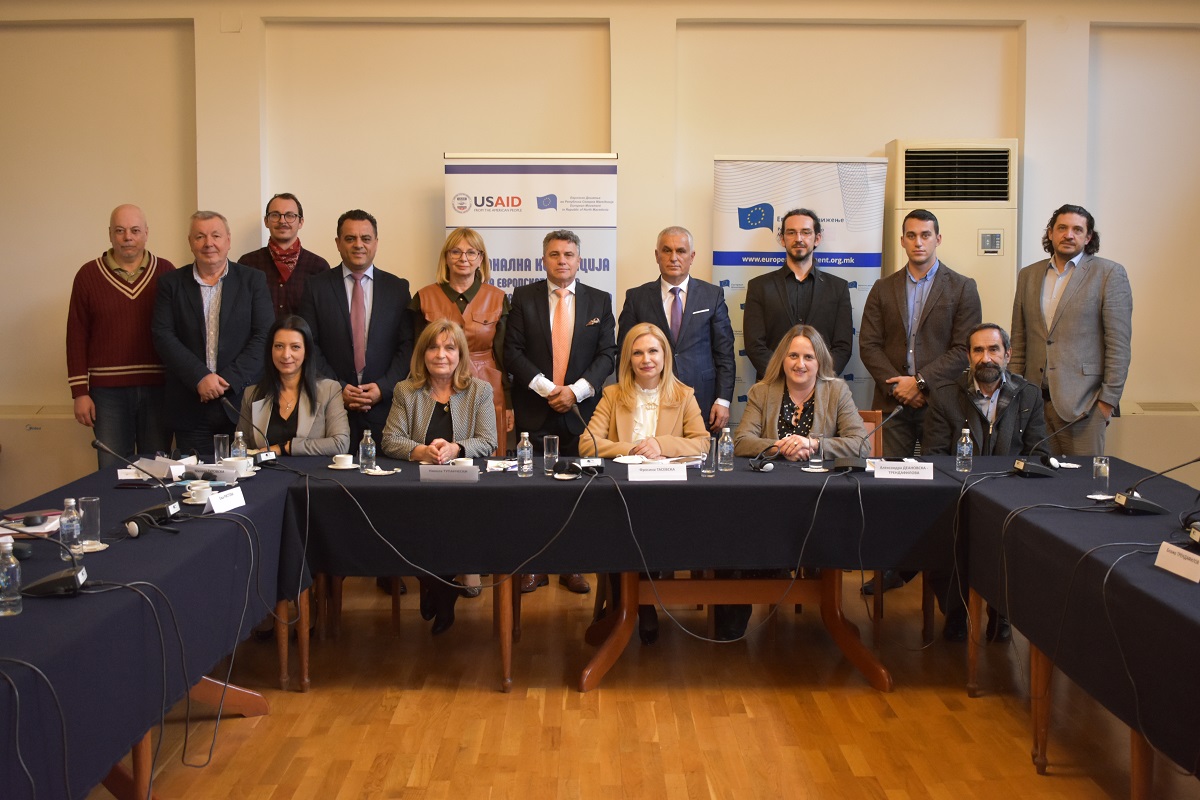
On November 10, 2021, in the Parliamentary Club, we held the ninth session of the Working Group 3 – Judiciary and Fundamental Rights (Chapter 23) on topic “New Report of The European Commission – old problems: How to be more efficient in pronouncing and executing the measure of confiscation of property “. The debate was attended by the Deputy Head of the Delegation of the European Union, Julian Vassalo, the Slovak Ambassador, Henrik Markus, Macedonian and Slovak legal experts, lawyers, university professors, as well as representatives of the Public Prosecutor’s Office, the Basic Criminal Court, the Agency for Confiscated Property and financial police and financial intelligence departments.
The participants in the debate concluded that confiscation of property is one of the most effective, important and relevant tools in the fight against corruption and economic crime. The legal framework regarding the confiscation of property in the country, as it was concluded, is inconsistent and has many inconsistencies, and it is essential to work on eliminating inconsistencies between institutions and strengthening inter-ministerial cooperation.
The confiscation of property and property benefits is one of the most effective tools, said the head of the Department of International Law and European Affairs at the Office of the Public Prosecutor in Slovakia, Ladislav Mayernik, conveying the Slovak experience.
“Criminals should be hit where it hurts the most, and that is to take their loot. It sends a message that the crime did not pay off,” said the Slovak expert.
He said much of the profits remained in the hands of criminals, citing the fact that EU criminal revenues are over 110 billion euros a year, but despite all these efforts, the rate of confiscation of criminally acquired property in the EU is only 1.1 percent, which, in his view, is disappointing. As he said, within the strategy 2019-2024, the EU has adopted directives with a package of proposals for confiscation of property, in order to protect the legal economy and strives for all measures to be properly implemented to keep pace with all trends in the internal market. There is also an Anti-Money Laundering Directive and a Freeze and Confiscation Directive. He believes that financial investigations should be multidimensional and comprise all types of organized crime criminal investigations, use joint investigation teams, use Europol facilities and develop a comprehensive action plan for financial investigations.
Mayernik added that it was also important to strengthen co-operation with third countries in conducting financial investigations and in that sense the EU to strengthen the legal framework for the management of frozen assets, as well as to provide a more sophisticated platform between financial intelligence departments.
Julian Vassalo, Deputy Head of the European Union Delegation, said it was critical to carry out the country’s reform agenda in a timely manner.
“The legal and institutional framework exists, and great progress has already been made in passing some of the laws. In order to strengthen the judicial system, it is critical to consistently implement the legal framework. Progress has been made in this regard as the country has continued to investigate several cases of high-level corruption, strengthened the role of the anti-corruption institution, but “More efforts are needed in the area of money laundering,” Vassalo said.
The National Coordinator of NCEU-MK and President of the European Movement in the country, Professor Mileva Gjurovska, in her address stated that considering the consequences of corruption, international analysis shows that for every euro appropriated in a criminal way, public resources become poorer for euros. She pointed out that the measure of confiscation of property is very important in preventing and fighting corruption, because its absence in the punitive measures can send the message that the resources gained through the abuse of public office can be used smoothly.
“This situation raises corruption to the level of the norm by diverting people’s interest from activities to corrupt activities, best expressed through the sentence created by the people, ‘Who got rich from work today?’ The conclusion is that instead of using their talent and ability to work to create wealth, individuals focus on redistributing public resources, which are becoming increasingly scarce, and the result is over-indebtedness of states, concluded Gjurovska.
Nikola Tupancheski, professor at the Faculty of Law “Iustinianus Primus”, stressed that the confiscation of property is one of the most important and relevant tools for combating economic crime.
“Confiscation of property is an instrument or mechanism that will make it possible to deny criminal proceeds or proceeds of crime. “The EC report states that there is a positive shift in things here, but the essential question is whether there are too many expectations in our society or the results we are achieving are too small,” he said.
According to Tupancheski, the fact that in the country in the last 10 years, there aren’t cases of confiscation in any city (except Skopje), says that we need to change the way things work. The upgrade or the instrument extended confiscation is more critical, ie the confiscation should be pronounced without a final verdict, which in practice has not been pronounced in Macedonia, although it has existed since 2009. One of the reasons for this problem, as he said, is the legal ambiguity, due to which the new Criminal Code and the Law on Criminal Procedure are currently being worked on, which is an significant opportunity to correct these matters.
Another problem is the mismatch between the institutions. That is the factor of inter-ministerial cooperation. There are seven institutions that specialize and should implement this measure, confiscation of property and property benefits, but there is no coordination. Tupancheski added that from January 1, 2022 it has been announced that there will be a new platform where there will be interoperability and all institutions will be interconnected, and thus the degree of cooperation between them will be increased.
Frosina Tasevska, State Adviser for European Integration at the Ministry of Justice, noted that the Criminal Code is largely in line with EU standards with a high score of five, according to the EC, but on the other hand it has been concluded that there are a number of national strategies to fight against organized crime, terrorism, migrants… and the next thing that needs to happen is their practical application.
“As a problem that we must mention, which occurs in cooperation with the EC, because they provide us with statistics on an annual basis, is the problem with statistics on confiscation of property. This means that we do not have the same data, we do not have a unified way of keeping statistics from the aspect of confiscation of property and property gain and confiscated items, “said Tasevska.
Lence Ristovska, prosecutor in the Public Prosecutor’s Office – Skopje, pointed out that the legal framework regarding the confiscation of property has many inconsistencies.
“Often when we talk about the measures for temporary securing of property claims, we say that they are approved by the Council at the main hearing, but the legislator does not use the term main hearing here, but uses the term search, which is a recurrence of the previous legislation. Also, when the measures for temporary security of property are determined, Article 535 of the LCP refers to Article 194, although that article does not provide for special measures and it is a technical non-compliance with the law, she said. According to her, all the omissions of the legislator indicate that the legislator did not have a systemic approach when regulating these measures.
“All illogicalities in the Law on Criminal Procedure, in the part how the measures for temporary security are regulated, should be promoted and we should address them in order to ensure equal access of the legislator in relation to all measures for temporary security, but first you have to take a strategic approach where we would move with these measures,” added Ristovska.
The Deputy Director of the Financial Police Directorate, Besim Deari, said that the Directorate is active in undertaking and actions related to financial investigations that it undertakes on its own initiative, at the request of the competent prosecutor and other institutions, which indicate the existence of grounds for suspicion for a committed crime, and on the basis of which the existence of illegally acquired property can be determined.
“Financial investigations where there are grounds for suspicion of a crime or illegally acquired property is a complex process that requires time and great resources. The investigations themselves are not just a check of bank accounts, but they are a comprehensive investigation and obtaining operational data to determine the status of illegally acquired property registered in one’s own name or someone else’s,” said Deari, adding that due to the volume of investigations, their capacities needs to be strengthened.
The judge in the Basic Criminal Court Skopje, Olja Ristova, referred to the procedures conducted in the Basic Criminal Court, as well as to the EC Report which recommends to increase the number of verdicts in cases of higher level corruption, followed by confiscation. .
“It was concluded here that in 2020 the accounts in one case were frozen, while in two cases temporary measures were imposed to ban the use, alienation and disposal of real estate. “In three cases of alleged corruption with a first instance decision, which is not final, money and luxury goods were confiscated, while in 2021 in one case, movable and immovable property and shares of significant value were frozen,” said Ristova.
The director of the Agency for Management of Confiscated Property, Faton Asani, said that the Agency is the last link in the confiscation chain. He believes that the Agency should actually receive a finished product from the judicial institutions, and that they should be its executors.
Blazo Trendafilov, director of the Financial Intelligence Unit, stressed that the Office’s obligation is to detect illegal funds entering the system, adding that the private sector is also obliged to report suspicious financial activities.
Darko Avramovski from the All for Fair Trials coalition says that it is necessary to improve the current legal solutions, because the laws themselves have ambiguities that contribute to the non-use of the measure.
“There is a lot of unused and that is the main problem, because no practice has been established, and on the other hand there is no uniform methodology between institutions to monitor the implementation of the measure and data collection,” said Darko Avramovski.
For more successful and more frequent implementation of the confiscation measure, a law on the origin of property has been prepared and is expected to be passed in the Parliament. The draft version of the law envisages confiscation of property of all those who will not be able to prove the origin of the property worth over 30 thousand euros that was acquired the previous year, and it will apply to all citizens, in addition to officials.
Сподели


