
Third Session of Working group 4 – “Migration and security challenges”
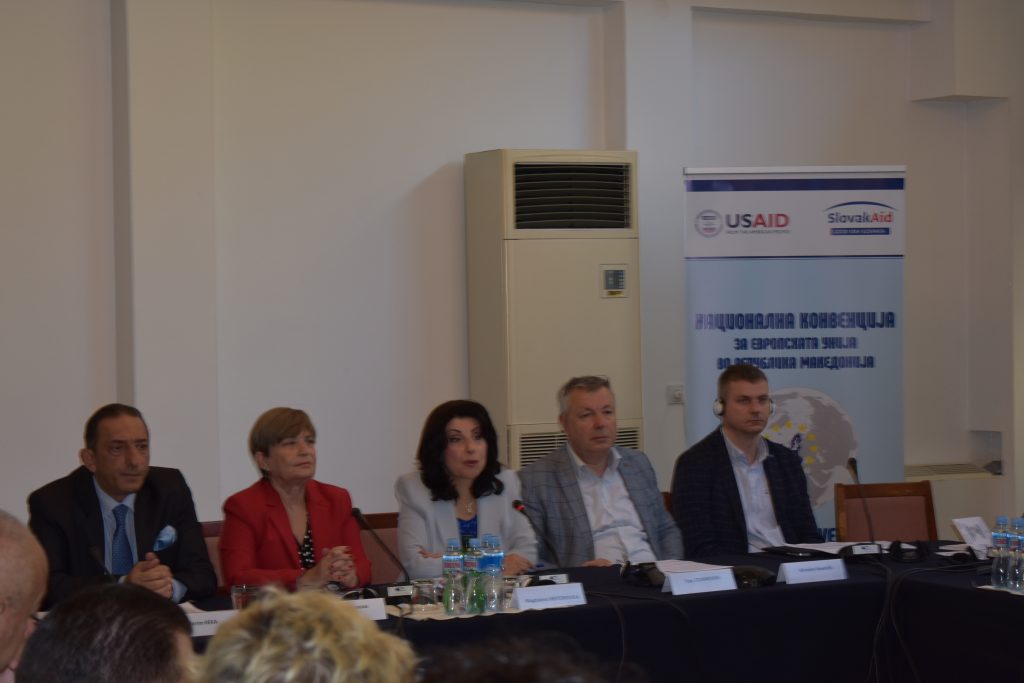
Premises: Club of Deputies – Skopje.
Participants: Magdalena Nestorovska (State Secretary Ministry of Internal Affairs in Republic of Macedonia), Mileva Gjurovska (National Coordinator of NKEU-MK), Blerim Reka (Professor at the South East European University, Tetovo), Trpe Stojanovski (Professor at the Faculty Security Studies, Skopje), Miroslav Hovančík (senior officer specialist, Risks Analysis and Statistics Unit, Slovakia), Marinko Kochovski (Ministry of Internal Affairs in Republic of Macedonia)
There were more than 50 participants to the session, WG 4 members and guests – Ambassadors, judges, university professors, NGO activists, Government officials, as well as, other interested individuals.
Topic/discussion:
The topic of this session of Working group 4 was “Migration and security challenges”. The national coordinator of NKEU-MK, professor Mileva Gjurovska, noted that the issue about illegal migration is not closed and that another wave of migrants going through the same routes is still possible. Although the routes seem to be closed, there are a lot of cases where hundreds of migrants cross the borders illegally.
Co-chair Magdalena Nestorovska, the state secretary of Ministry of Internal Affairs, stressed that Republic of Macedonia went through a tough period, however the response was positively assesed by the other Balkan states as well as the European Union which served as another motive to continue to work hard and be ready for every possible scenario.
Professor Blerim Reka, from University of South East Europe – Tetovo, said that two years ago Macedonia successfully managed the large number of migrants from the Middle East that saw the route thorough the Balkans as a way to European Union, but also noted that the challenge is not yet closed. The population of non-EU citizens that reside in countries part of European Union is at all time high at 5.8%, which results in anti-migrant feelings and a change in political climate in some of the EU member states. From August 2017 to August 2018, Croatia has 31% increase in illegal migration, compared to last year.
Professor Trpe Stojanovski, from Faculty of Security, said that according to the statistics from EU, the number of people trying to illegally cross the border of Republic of Macedonia is up 88% in 2018, compared to last year. He noted that this is an indicator of the actual state on the issue currently. Illegal migration has several challenges, starting from the number of victims on the road to Europe, which is rising, but also the possibility of terrorist and other dangerous behavior.
Miroslav Hovančík mainly focused on border guarding and the situation in Slovakia regarding illegal migration. He presented why is risk analysis so important, stressing that we do not have limitless capacities and when decisions have to be made it is important to make those decisions based on knowledge and experiences. He also spoke about Frontex as well as the CIRAM model which is an intelligent cycle that looks at the risk as a threat measured by the magnitude and the likelihood -through vulnerability / the level of vulnerability of MS whether they are transit or the destination.
The representative from Ministry of Internal affairs, Marinko Kochovski, presented statistics about migrant movement during the 2015/2016 wave. He spoke about the role of united European forces that helped the border security and noted that Republic of Macedonia will soon join them.
Сподели


