
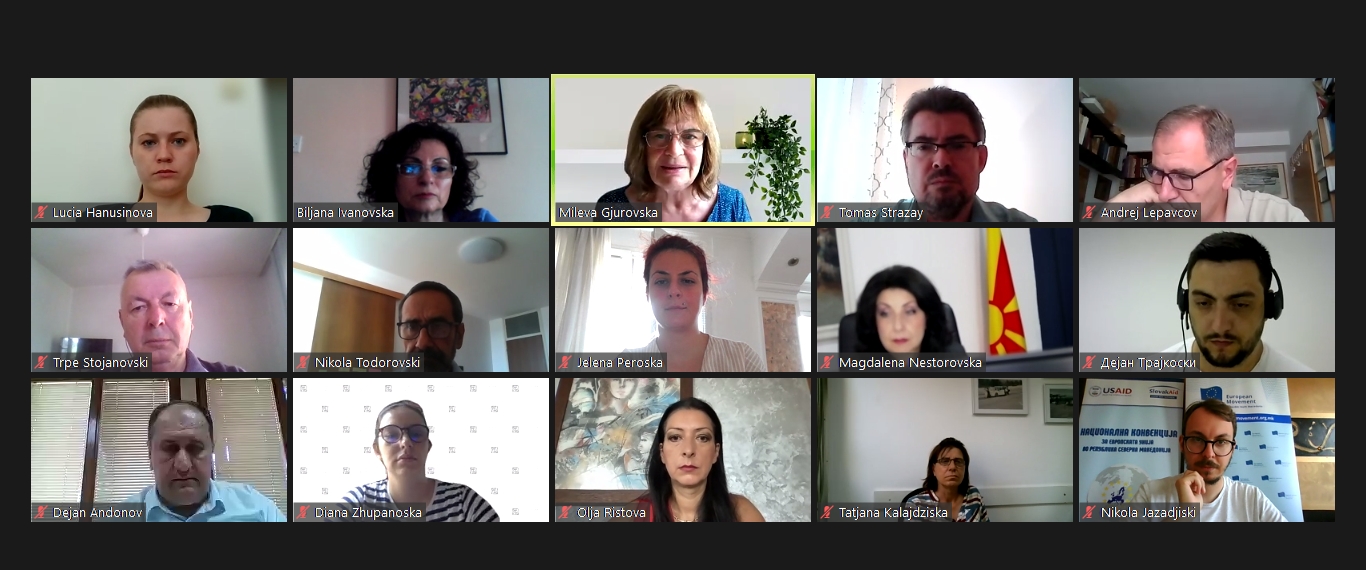
The ninth session of WG-4, Justice, Freedom and Security (Chapter 24) was held on 6 July 2021 on the ZOOM platform, with the presence of over 40 participants from the country, as well as experts from Slovakia and Norway. At the Session, with an analytical approach and in an open and constructive atmosphere, the phenomena and shortcomings that stand in the way of the implementation of the anti-corruption legislation were discussed. When marking the key points for more efficient dealing with corruption, due to the topicality of some worrying affairs (illegal issuance of identification documents, etc.), special emphasis is placed on corruption in the police and other security institutions.
Mileva GJUROVSKA, the President of the European Movement and National Coordinator of NCEU-MK, in the invitation for the session and in the introductory address emphasized that the problem of corruption is a serious obstacle for the establishment and functioning of the rule of law. In this context, declarative statements are not enough, but specific activities to prevent corruption are needed: horizontal harmonization and cooperation in the investigation procedure, sanctioning the perpetrators of corrupt practices by the relevant institutions, anti-corruption review of the legislation for a clearer definition of the contents for protection against corruption, building the mechanisms for external control and giving greater competence and resource equipment to the independent bodies, as well as transparency towards the public regarding the public procurement procedures and when appointing and dismissing the candidates for performing public office. The steps in the fight against corruption begin with the recognition of this as a serious threatening problem, and then continue with open talk about its occurrences and support for measures to prevent it. We need public awareness and a state of society where laws should apply equally to all. Impunity for corrupt appropriation of national wealth impoverishes the state and condemns long-term underdevelopment. It is possible to create a social climate of lack of prospects, as well as passivity of the citizens, which leads to even greater incapacity in economic and political terms.
Tomas STRAZAY, Director of the Slovak Foreign Policy Association (SFPA), expressed satisfaction that in the second phase they are also part of the NCEU-MK project whereby they can contribute to the reform processes for EU membership of the country. However, EU accession is not a universal cure for all problems. Slovakia marks 17 years of EU membership, but due to the prevalence of corruption, fighting this phenomenon is still a particularly important area for Slovakia. The newly elected Slovak government won the support of the public with their determination and promise to fight the presence of corruption and restore confidence in the rule of law. Their findings are that the process of fighting corruption is important for both the pre-accession and post-accession phases of social development. The National Convention should keep in mind that the fight against corruption will not and must not end with the accession of the Republic of North Macedonia to the EU, but should continue for many years to come.
Magdalena NESTOROVSKA, State Secretary at the Ministry of Interior and Co-Chair of WG-4, pointed out that no country is immune to corruption, and that the fight against this evil has no beginning and no end. Corruption is present in all segments of our society and it is inevitable to have it in the police as well. Defining corruption in the police, she stated that it is any violation of proceedings and procedures, abuse of office or exceeding police powers for directly or indirectly promised, offered or expected benefit for oneself or someone else. Unprofessionalism and inadequate organization, employment of unprofessional staff, neglect of the criteria in the selection and training of employees contribute to this phenomenon in the police. In the Strategic Plan of the Ministry of Interior 2021 – 2025, the fight against corruption is set as the first priority. Every year they adopt an anti-corruption program that aims to establish a system of measures to identify the causes, conditions and factors that enable corruption. Effective fight against corruption is a complex formula in which all parts of the political will, normative solutions, institutional framework, effective implementation of laws, as well as institutional and personal integrity are equally important. The fight against corruption is not successful if it is led only by the Ministry of Interior and if the whole society is not successful in that fight. Only one segment of corruption cannot be cleaned, because it will spread from other parts of society and endanger the cleaned segment. In the Ministry of Interior, the fight begins with detecting and identifying the risk of corruption, as well as timely detection, proving and documenting corrupt behavior in which police officers are involved. The main goal is to reduce corruption and build anti-corruption awareness through appropriate training of employees, as well as by removing unprofessional conduct and non-compliance with codes of ethics, in accordance with European standards. Cooperation and data exchange with national and international institutions is a leading force and basis for building a sustainable system in the fight against corruption. A special Unit has been established in the Ministry of Interior, which also uses external mechanisms for control measures and activities in this area. Openness to the public is seen as a powerful weapon against corruption, which seeks to be hidden through its secrecy, ambiguity, and fogginess. Transparency and publicity is an environment that does not suit corruption. Therefore, public debates, open analysis of the situation, clear and precise instructions, concrete recommendations make an important part of an effective fight against corruption.
Andrej LEPAVCOV, Coordinator of WG-4, diplomat and member of the European Movement, paid attention to some international aspects of the fight against corruption, as one of the key problems of the countries in the region. Corruption weakens institutions, creates a serious problem for the security of states, and creates corrupt schemes that know no borders. That is why the Executive Order of the US Administration from the Magnitsky Act is of particular importance addressed to everyone in the Western Balkans and beyond (including EU member states), which warns corrupt leaders that action must be taken to change the discourse in the region. Lepavcov expressed agreement with the statement of the previous speaker Strazay that corruption in the EU is not 100% eradicated and that there is a long fight to reduce and eliminate it, at all levels. Regarding corruption in the region and in our country, there are three general problems: there is a lack of qualitative, visible reform changes, which will be felt by the citizens; all delays in the start of EU membership negotiations cause apathy; there is fragility and vulnerability to foreign influence. Corruption exists and strongly hinders democratic development and change, although the situation is identified by citizens as an unacceptable way of living in a society.
Trpe STOJANOVSKI, a continuous expert in RG-4, and a professor at the Faculty of Security Studies, raised the question of the state of anti-corruption legislation. Basically, the priority issues for every government and everywhere is the prevention and fight against crime. According to the indicators that monitor the level of corruption, our country, as well as the entire region, belongs to the group of highly corrupt countries. Statistical indicators are not to be ignored, but they are not always a realistic reflection of the situation. Over the past three decades, office holders have often said that serious and crucial reforms are being made, and that the changes that have followed have not gone in the right direction. The rule of law, among other things, was undermined by pardons (more than five), while numerous recommendations from international organizations remained unintegrated. According to him, it is a matter of functional irresponsibility, i.e., there is a lack of flow of procedures from beginning to end. The severe sanctions are not followed by measures to deprive the offenders of their illegal proceeds, which then causes citizens to distrust the legal mechanisms. The police are taking a number of measures that deserve encouragement, but unfortunately there are opposing processes that have not been fully clarified. Such is the case with the COVID 19 pandemic and the introduction of the curfew, which gives (imposes) competencies and powers to the police for which there was no prior preparation. Also, when a complaint is submitted to the Ministry of Interior for non-issuance of personal documents, the reply to the problem you have detected can only be obtained via e-mail.
Transparency is an important segment in the fight against corruption, but the assessment of how transparent the procedures are should be based on the perception of the citizens, and not to be built on the statements of the representatives of the state institutions. Referring to the functioning of external police control mechanisms, he noted that it is not effective. The mechanisms have been strengthened with the establishment of a special Unit in the Public Prosecutor’s Office, but an urgent change is needed in the Law on the Ombudsman, regarding the stalled participation of the representatives of the civil society. We belong to a group of countries in the region with the largest brain drain and low capacity to retain talent. According to the polls, the most common reasons for leaving are: inability to find employment, poor education system, unsatisfactory health system, problem with the rule of law and lack of prospects for development. The start of EU membership negotiations can do the most to establish control mechanisms for more effective rule of law, standards and values that prevent corruption.
Zuzana PETKOVA, the Executive Director of the non-profit organization “Stop Corruption” from Bratislava, while presenting herself emphasized that she represents the organization that is particularly effective in the fight against corruption in Slovakia. They cooperate with the Government, the Parliament and other state institutions in the preparation of legal solutions, participate in the control of public procurement, support investigative journalism in cases of high corruption, protect whistleblowers, work to raise public awareness through informal education and campaigns. The organization has 80 volunteers engaged in raising public awareness in fighting corruption. In that fight, the whistleblowers have a very important role, for which, according to a 2019 Law, they have opened an Office for Protection as well. They provide psychological, financial and legal assistance, striving for none of them to be fired, to be trained to point out corrupt deals, and for the indications they have a financial reward as well. NGOs are not funded by Soros (as it is often speculated), but have the opportunity to receive funds from tax revenues, and this is decided by the citizens. According to Transparency International 2020 index, Slovakia is one of the worst ranked countries in the EU, ranking 49th. Changes are possible only if corruption is not tolerated by the citizens for whose promotion they work dedicatedly and engaged. An example of their activity was the petition of five non-governmental organizations, which annulled the proposal of the then Deputy Prime Minister, which initially proposed that the public procurement deals with a value of less than 5.3 million euros from the EU funds should be accelerated with direct contracts in private. Thus, they estimate that about one billion euros could have avoided the radar of public control. This success has been achieved through extensive cooperation of the non-governmental sector which has managed to mobilize the public fighting possible corrupt deals of senior government officials.
Biljana IVANOVSKA, the President of the State Commission for Prevention of Corruption (SCPC), stressed that the distrust of citizens in the institutions stems from non-compliance with the rules of the game, which, for some, apply and for some do not. This speaks of the immaturity of society itself and the derogation of rules, which are left to personal consciousness and responsibility. The situation with corruption is serious, as shown by the numerous cases and reports submitted to the SCPC. On their part, they noted a series of conflicts of interest, the presence of impunity, political influence and the non-rule of law. There is a lack of personal and institutional integrity, insufficient transparency, as well as inconsistency and ambiguity in the legislation. In the two and a half years of existence and functioning so far of the present SCPC, barely 1/3 of their indications have been accepted despite the reports of international organizations recommending compliance with the recommendations of independent regulatory bodies. Through the analysis of the reports, they determined that the judiciary, the executive branch, the institutions that decide in the field of town planning and the municipalities are at the highest risk of corruption, abuse of office and the possibility of conflict of interest.
Also, a high risk of corruption is the domain of employment in the public administration where there is unlawful conduct and abuse of discretionary power of managers (30%). In employment procedure, the crucial factor is the interview, instead of the success and the points won. The manner of conducting an interview through structured questions and their evaluation is not regulated by law or bylaws. In state-owned joint stock companies, no rules are regulated regarding education and other qualifications, but decision-making is the exclusive right of the manager. In acting upon the complaints, they noticed a change in the systematization of the jobs, creation of new jobs, change of the qualifications and the necessary work experience so that the vacancies are adjusted to known persons in advance who should be employed. Employment is recognized by the general public as a phenomenon related to nepotism, clientelism and party affiliation, which creates huge dissatisfaction among citizens. Appointment and dismissal of managers in public enterprises and companies is a proven way of employing persons related to the parties and is recognized as a way of division of offices among the ruling political parties, i.e., the spoils system. No law provides for sanctions for such conduct. They also pointed out the multiple appointment of individuals to the position of acting office holder, nominally a temporary replacement function (a striking example is the appointment of an individual continuously 7 times to this position). They recommended the adoption of a Law on the Election of Senior Management Staff, but although the procedure has been initiated, its adoption has been delayed. The Law on Legalization of Illegal Buildings and the Law on Strategic Partnership for Infrastructure Projects were assessed as raising high concerns. With the adoption of the National Strategy for Fight against Corruption and Conflict of Interest, for the first time they had the opportunity to present their analysis and recommendations in the Parliament of the Republic of North Macedonia. The increase of the powers of the SCPC is to be welcomed, and only after a long period of time the spatial conditions and equipment for normal functioning have been recently provided.
Odd BERNER-MALME, a Norwegian expert, senior police officer, spoke about the work of the Norwegian Center for Defense Integrity and Security and experiences in the long-term fight against corruption. The center is funded by the Ministry of Foreign Affairs and is operated by the Ministry of Defense. They establish significant international police cooperation with governments and responsible institutions to exchange experiences and good practices. They also developed a special project for cooperation with the Western Balkans, which includes the respective ministries of Macedonia, Albania, Montenegro, Bosnia and Herzegovina, and Kosovo. They have been present in the region for many years in the role of coordinator of a cooperation network in the implementation of anti-corruption standards and procedures. They focus on education, information exchange, monitoring of public procurement resources, good practices and especially the integrity of the police. They believe that integrity, responsibility and accountability should be a characteristic of every police officer. Police officers thus ensure the trust and support of citizens and the public of the police, as professional, honest and responsible. A particularly important element in the fight against corruption is public trust, which depends on the good work of the police. If the condition is not like this, the reputation is damaged, and then it takes a long time to restore it. In addition to whistleblowers, they have developed a system through which ordinary citizens and fellow police officers can report inappropriate behavior by individual police officers. He agreed with a number of assessments on the extremely important issue of institutional and personal integrity of the police and hopes that the recommendations that will emerge from the debate will be accepted and implemented.
Dejan ANDONOV, Deputy Minister of Interior and Head of the Department of Internal Control, Criminal Investigations and Professional Standards, stressed that police integrity has a special role in the effective fight against crime and corruption. For that purpose, the Department that he manages has competencies to: exercise control over the respect and protection of human rights and freedoms in the performance of police duties; undertake measures and actions for detection and suppression of criminal acts with elements of corruption and other forms of corrupt behavior; apply operational and tactical measures and actions for securing material evidence and file criminal charges to the competent prosecutor’s offices; cooperate with related services and international organizations and institutions whose primary goal is the fight against corruption and the protection of human rights and freedoms. They are committed to detecting and sanctioning all forms of unprofessional conduct. The most common forms of violation of police integrity are identified as follows: abuse of office and authority, accepting bribes, extortion, abuse of personal documents, acceptance of gifts and services, disclosure of officially classified information. GRECO (Fifth Evaluation Report) has made a number of country recommendations, most of which relate to the Ministry of Interior. According to them, the conditions during the first employment were amended with two new conditions: not to be members of the parties or party bodies, as well as to have passed the integrity test. New legal provisions have been proposed for prevention of corruption and abuse of office through continuous checking and control of actions in a simulated situation, identical to the tasks and activities. A Code of Ethics for the conduct of MoI employees has been adopted and programs for strengthening ethical capacities have been prepared through trainings and workshops on issues such as conflict of interest, police integrity, political neutrality and others. Regarding the property and the conflict of interests of the top managers and employees in certain positions in the Ministry of Interior (MoI), it is recommended that they submit a separate asset declaration based on an amendment to the Law on Police. One of the most important tools in the fight against corruption for the Ministry of Interior is building high police integrity, which creates trust, respect and support between the police and citizens.
Aleksandar NACEV, Dean of the Faculty of Detectives and Criminalistics at the European University – Skopje, said that in the discussion, as well as in the Draft-recommendations of the session, there is a conclusion about the insufficient professionalism of the state security institutions. He pointed out as a negative example the integrity test for hiring employees of the National Security Agency. He believes that we cannot boast of good and effective integrity tests. Perceptions of corruption need to be standardized, and officials and managers need to take integrity courses, as is the case in the EU. Such knowledge would help in the management of state institutions and would reduce corruption to a degree that would not have a negative effect on the country’s image internationally. There is a culture of impunity, procrastination and outdating of acts of corruption, which is a kind of additional incentive to commit crimes. Of particular concern is the lack of attention to high-corruption cases, and the lack of court rulings on such cases. The position of civil society organizations as an integral part of the fight against corruption is insufficiently functional. The Draft-Recommendations pay attention to the role of the civil society organizations and the Ombudsman in fulfilling the new competencies regarding the fight against corruption, which unfortunately are still non-functional. We have several anti-corruption institutions in the state administration, and even a Deputy Prime Minister with such a function, but a certain level of professionalism with integrity must be achieved, as a precondition for recognizing and eliminating corruption. Our citizens need to be sure that the state apparatus and officials are committed to improving their lives, not to gaining their own benefit and avoiding sanctions. In order to strengthen the anti-corruption front, to which the NCEU-MK session also contributes, we need the political and state will to be raised to a higher level.
Nikola DUJOVSKI, Dean of the Faculty of Security Studies at the University “St. Kliment Ohridski”- Bitola, emphasized that for the implementation of anti-corruption policies it is necessary not only to have the existence of political will but also operational readiness. The European Partnership Network provides a common access to several international institutions such as Europol, Interpol and others, which gives the police a substantial advantage in the fight against corruption. But it is not present in all segments, as is the case with the courts, customs and financial authorities. In all countries, even those cited as examples, there are three types of corruption: bureaucratic or low-level corruption, criminal corruption, and political or high-level corruption. Citizens are most likely to encounter low-level corruption of police officers, especially in obtaining decisions, approvals and permits. Regular and continuous checking of the integrity of police officers contributes to the narrowing of the space for the penetration of criminal schemes. Political corruption, related to the phenomenon of a captive state, (which we went through) present in the conduct of false investigations, leaks of confidential information to political parties, etc., is overcome by accountability and transparency to the public. A network for communication with the media and the citizens has been built (which until recently was unthinkable), through which the public is informed on a daily basis about the activities of the police. Regarding the recommendations of GRECO, serious progress has been made with the public announcement of the budget of the Ministry of Interior. Every citizen can easily notice how every denar was used in public procurement, published on the website of the Ministry. It should be noted that the Center for Civil Communications for years collects data on transparency according to which the Ministry of Interior is on a high place, with continuous progress – from 59.5% in 2016 to 87% in 2021. There is a readiness and will to build appropriate and applicable procedures for positive results in the fight against corruption. At the same time, we should not be blind to the fact that corruption is present all around us and therefore all common means, science and theoretical rules should be used, as well as the practice in other countries to build a functional system that will allow citizens less corruption, and a better life.
DISCUSSION
After the expert addresses, a discussion was opened in which questions were asked, observations were made and recommendations were given on the following issues: situation in Slovakia regarding the financing of civil society organizations, experience of the SCPC cooperation with whistleblowers as an important point in the fight against corruption in relation to citizens, building police integrity and the role of investigative journalism in the fight against corruption.
In Slovakia, with 2% of tax liabilities, companies or legal entities stimulate the strengthening of civil society organizations. Interest was aroused in the way selection is made for the allocation of these funds. Answering the question, Slovak expert Zuzana Petkova stated that the funds are not received from the Government, but on the basis of the data on the activities and the financial reports submitted to the State Register, the donors independently decide to whom the funds will be allocated. (Participants assessed this way of allocating funds as particularly interesting, but our problem is the lack of an electronic database, which opens the possibility for double funding of the same projects.) For various projects from EU funds, the previous Slovak government allocated funds to civil society organizations up to 300,000 euros. Stop Corruption has refused to take such funds because it would hinder it in its role as a critic and controller of government measures.
The Law on Whistleblowers was adopted in 2015, and entered into force in 2016, on the basis of which 35 reports were submitted to the SCPC. They recommended that protection be provided to whistleblowers, but there are also occurrences of terminating their jobs. There are serious indications of such procedures by the Labor Inspectorate, as one of the institutions for protection of whistleblowers. However, there is an upward trend and an increased number of substantiated reports by citizens as whistleblowers. The need for a public campaign on the importance of whistleblowers in combating corruption, and above all to ensure a higher level of their protection, was noted.
According to Judge Olja Ristova, corruption is a broad, inexhaustible topic, but research shows that one of the main reasons for the emigration of young people is corruption. Citizens have experienced the existence of selective justice and abuse of power in a blatant way with the recent delay in issuing ID cards, passports and driver’s licenses. As a trial judge in the case of illegal issuance of passports to persons wanted by international arrest warrants, she made decisions on 11 persons, 7 of whom are already in prison. According to unofficial information she has received, the citizens still face the problem in context when decisions on issuance of their documents are made with connections, out of turn and by all kinds of corruption. (MoI Director of the Department of Internal Control Andonov informed that they have not received any new complaints, and that they are ready to check the aforementioned circumstances). The integrity of the authorized officials should be completed with appropriate trainings and controls, as well as by changing the legal acts that would regulate the procedures. It is necessary to raise the awareness of the employees that by receiving gifts, their unprofessional behavior starts and then deepens in corruption.
Regarding the financing of the activities of the civil society organizations (CSOs), Professor Konstantin Minovski pointed out their huge party affiliation, as expressed by political parties supporting critical organizations, when those parties are in opposition and vice versa when they are in power. Fundamental reforms are needed with a clearly defined desire to clean up corruption that will be transparently monitored. Agreeing with previous statements, he stressed that it is necessary to change the overall socio-political matrix in such a way that the laws apply equally to all citizens. Transparency plays an important role in this, to which investigative journalism on corruption cases contributes particularly significantly.
The participants agreed with a series of findings in the previously submitted Draft Recommendations from the 9th session of WG – 4 such as: the need to define and specify the criteria for selection of senior positions, to strengthen the legislation with the provisions saying that persons convicted of financial offenses or violence may not be elected or appointed to public office, to initiate training of anti-corruption staff in all relevant institutions, to establish mechanisms similar to those of other countries to support investigative journalism, and to fight corruption to increase transparency to the public.
An open and constructive discussion was held on several issues related to specifying and supplementing the Draft-Recommendations: 1) The need for legal solutions during their drafting to pass the review by the State Commission for Prevention of Corruption was emphasized, which has so far been identified as a bright spot in the fight against this illegal activity; 2) An opinion was presented that investigative journalism and projects for financing civic activities in the fight against corruption in order to avoid their instrumentalization should not be funded by the Government. Then the opposite view has been expressed that it is illogical for projects and activities that are predominantly funded by international organizations and foreign countries not to be financially supported by their own country. A request was made that the proposal be carefully formulated; 3) It is estimated that the creation of an appropriate electronic database would be a significant contribution to the transparency and support of the activities of civil society organizations in the fight against corruption; 4) The need has been pointed out that the Recommendations from the ninth session, in addition to distribution to the participants, for final adoption and their publication on the NCEU-MK website, should be submitted to the relevant government ministries, Deputy Prime Minister for Anti-Corruption, Ombudsman and the Public Prosecutor’s Office.
Сподели


